


Download Ebook Helping People Help Themselves: From the World Bank to an Alternative Philosophy of Development Assistance (Evolving Values for a Capitalis
Nevertheless, checking out guide Helping People Help Themselves: From The World Bank To An Alternative Philosophy Of Development Assistance (Evolving Values For A Capitalis in this site will lead you not to bring the published book everywhere you go. Simply save guide in MMC or computer system disk and they are available to review at any time. The thriving air conditioner by reading this soft documents of the Helping People Help Themselves: From The World Bank To An Alternative Philosophy Of Development Assistance (Evolving Values For A Capitalis can be leaded into something brand-new behavior. So currently, this is time to show if reading could enhance your life or not. Make Helping People Help Themselves: From The World Bank To An Alternative Philosophy Of Development Assistance (Evolving Values For A Capitalis it surely function and obtain all benefits.
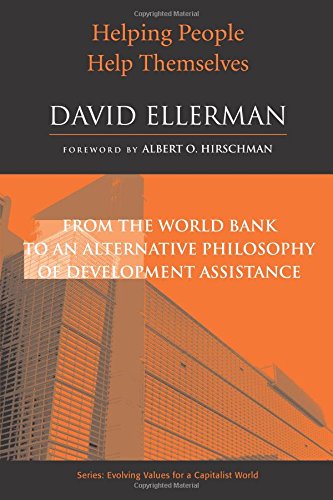
Helping People Help Themselves: From the World Bank to an Alternative Philosophy of Development Assistance (Evolving Values for a Capitalis

Download Ebook Helping People Help Themselves: From the World Bank to an Alternative Philosophy of Development Assistance (Evolving Values for a Capitalis
This is it the book Helping People Help Themselves: From The World Bank To An Alternative Philosophy Of Development Assistance (Evolving Values For A Capitalis to be best seller just recently. We offer you the best deal by getting the incredible book Helping People Help Themselves: From The World Bank To An Alternative Philosophy Of Development Assistance (Evolving Values For A Capitalis in this website. This Helping People Help Themselves: From The World Bank To An Alternative Philosophy Of Development Assistance (Evolving Values For A Capitalis will certainly not only be the sort of book that is challenging to find. In this site, all sorts of publications are given. You could search title by title, author by writer, as well as author by author to find out the most effective book Helping People Help Themselves: From The World Bank To An Alternative Philosophy Of Development Assistance (Evolving Values For A Capitalis that you could check out now.
If you want truly get guide Helping People Help Themselves: From The World Bank To An Alternative Philosophy Of Development Assistance (Evolving Values For A Capitalis to refer currently, you should follow this web page always. Why? Remember that you need the Helping People Help Themselves: From The World Bank To An Alternative Philosophy Of Development Assistance (Evolving Values For A Capitalis resource that will provide you right assumption, do not you? By seeing this website, you have actually started to make new deal to always be up-to-date. It is the first thing you could start to get all profit from being in a site with this Helping People Help Themselves: From The World Bank To An Alternative Philosophy Of Development Assistance (Evolving Values For A Capitalis as well as various other collections.
From now, finding the finished site that sells the completed publications will be several, yet we are the trusted website to visit. Helping People Help Themselves: From The World Bank To An Alternative Philosophy Of Development Assistance (Evolving Values For A Capitalis with simple link, easy download, and finished book collections become our better services to get. You can find and also make use of the advantages of choosing this Helping People Help Themselves: From The World Bank To An Alternative Philosophy Of Development Assistance (Evolving Values For A Capitalis as every little thing you do. Life is always establishing and you require some new book Helping People Help Themselves: From The World Bank To An Alternative Philosophy Of Development Assistance (Evolving Values For A Capitalis to be recommendation constantly.
If you still need much more books Helping People Help Themselves: From The World Bank To An Alternative Philosophy Of Development Assistance (Evolving Values For A Capitalis as recommendations, visiting browse the title and also theme in this website is offered. You will certainly find even more lots publications Helping People Help Themselves: From The World Bank To An Alternative Philosophy Of Development Assistance (Evolving Values For A Capitalis in various disciplines. You could likewise when feasible to check out the book that is already downloaded. Open it and save Helping People Help Themselves: From The World Bank To An Alternative Philosophy Of Development Assistance (Evolving Values For A Capitalis in your disk or gizmo. It will ease you any place you require the book soft file to read. This Helping People Help Themselves: From The World Bank To An Alternative Philosophy Of Development Assistance (Evolving Values For A Capitalis soft documents to check out can be referral for everyone to improve the skill and capability.
David Ellerman relates a deep theoretical groundwork for a philosophy of development, while offering a descriptive, practical suggestion of how goals of development can be better set and met. Beginning with the assertion that development assistance agencies are inherently structured to provide help that is ultimately unhelpful by overriding or undercutting the capacity of people to help themselves, David Ellerman argues that the best strategy for development is a drastic reduction in development assistance. The locus of initiative can then shift from the would-be helpers to the doers (recipients) of development. Ellerman presents various methods for shifting initiative that are indirect, enabling and autonomy-respecting. Eight representative figures in the fields of education, community organization, economic development, psychotherapy and management theory including: Albert Hirschman, Paulo Freire, John Dewey, and Søren Kierkegaard demonstrate how the major themes of assisting autonomy among people are essentially the same.
David Ellerman is currently a Visiting Scholar in the Economics Department at the University of California at Riverside.
- Sales Rank: #2337137 in Books
- Published on: 2006-01-05
- Original language: English
- Number of items: 1
- Dimensions: 9.00" h x .90" w x 6.00" l, 1.06 pounds
- Binding: Paperback
- 354 pages
Review
"A towering achievement. It outdoes Sen and Hirschman in its reach across economics, management theory, psychology, sociology, mathematics and philosophy. The result is a coherent alternative "way of seeing" the relationship between aid organizations based in rich countries and aid recipients based in poorer ones, and some practical suggestions on how to re-engage the aid agencies more as "helpers" than as "doers". Along the way it fairly sizzles with insider insights into the workings of the World Bank." - Robert Hunter Wade, Development Studies Institute, London School of Economics "Ellerman provides a compelling humanist understanding of how economic development aid can succeed, if only people and nations are enabled to help themselves." - William Greider, author of The Soul of Capitalism: Opening Paths to a Moral Economy"
About the Author
David P. Ellerman is currently a Visiting Scholar at the University of California at Riverside.
Most helpful customer reviews
11 of 11 people found the following review helpful.
Helping hand operating through a `Development Church'?
By Yevgeny N. Kuznetsov
Among many recent books on development assistance, this is a highly peculiar one. It does not discuss cross-country regressions (which are supposedly a sign of academic rigor) but it has many deep ideas illustrated by engaging and compelling examples.
`Helping people help themselves' has become a development motto bordering on a platitude. But how can you help people become self-sufficient? Major contribution of the book is formulation and unraveling of this fundamental conundrum of development assistance: paradox of supplying help for self-help, teaching another person to think things out for himself and the like.
The major novelty of the book is in chapters 3 and 4 where this conundrum is analyzed as parent-child, teacher-student, patient-doctor, manager-worker, all as examples of a general helper - doer relationship. If you thought that Soren Kiergaard's `passionate leap of faith', M. Gandhi' Satyagraha or Carl Rogers' non-directive therapy is a different world from development assistance, think again. Juxtaposition of major thinkers from various fields is compelling and does shed light on mundane conundrums of development assistance.
But the author is not only a renaissance thinker but he is also a `doing thinker' (an incorrect characterization from the point of view of the book, but I'll use it nonetheless to emphasize thinking informed by everyday reality): he spent ten years inside the World Bank. So he speaks with authority of one's own experience of how the Bank often provides `unhelpful help'. And not necessarily when it lends money but when it becomes `knowledge bank' as well. In the standard methodology of knowledge-based development assistance, it just knows relevant best practices and teaches and preaches them all over the world as a `global development church'.
Concluding part of the book asks the question `can the World Bank change?' and develops a proposal for change, a proposal which is so radical and demanding that the only answer is `no, the Bank can not change'. And this is the least satisfactory part of the book. Not because the author is wrong (he just as well can be right) but because the proposal for the Bank' change does not follow the thrust of the book itself. Following this thrust, the Bank would be viewed as yet another troubled country with its many (and unavoidable) structural limitations. The relevant question is whether one can encourage an autonomous change, a reform `inside-out' of this organization. This would have required a very close attention to heterogeneity of both the World Bank itself and its clients.
The Bank dealing, say, with Chile and the Bank dealing with neighboring Paraguay are literally two different organizations, although procedures, constraints and limitations are all the same (and it is a single country director which is responsible for both countries ), yet a demanding client (Chile) forces it to innovate and experiment, the way Paraguay is not. This is how internal heterogeneity of the organization (almost entirely absent, for instance at IMF) is being sustained. And as many countries say know `money we don't need and ideas we you don't have;, this internal diversity and heterogeneity is only bound to grow. So the question, at once humble and ambitious, is how the better performing (in the send of the book) segments of this extremely diverse and heterogeneous beast be expanded and given an opportunity to grow.
But that perhaps is a subject for the next book, to be written by `doing thinker' and `thinking doer' (a brutally pragmatic reformer yet with some capacity for self-reflection).
4 of 4 people found the following review helpful.
An alternative philosophy on development
By David Suze Manda
Ellerman eloquently gets the root understanding of the issue underlining the failure in development approach. Having understood that most of development agencies and institutions in particular World Bank either override or undercut the beneficiaries intrinsic motives respectively by the social engineering and the benevolent charity, Ellerman reveals to us how we need to start right where the people are and make sure that they are truly motivated.
Helping People Help Themselves: From the World Bank to an Alternative Philosophy of Development Assistance (Evolving Values for a Capitalis PDF
Helping People Help Themselves: From the World Bank to an Alternative Philosophy of Development Assistance (Evolving Values for a Capitalis EPub
Helping People Help Themselves: From the World Bank to an Alternative Philosophy of Development Assistance (Evolving Values for a Capitalis Doc
Helping People Help Themselves: From the World Bank to an Alternative Philosophy of Development Assistance (Evolving Values for a Capitalis iBooks
Helping People Help Themselves: From the World Bank to an Alternative Philosophy of Development Assistance (Evolving Values for a Capitalis rtf
Helping People Help Themselves: From the World Bank to an Alternative Philosophy of Development Assistance (Evolving Values for a Capitalis Mobipocket
Helping People Help Themselves: From the World Bank to an Alternative Philosophy of Development Assistance (Evolving Values for a Capitalis Kindle
0 komentar:
Posting Komentar